
Borrower Defense
Scam Warning
Be aware that scammers may try to contact you. As the Federal Trade Commission (FTC) says: Don’t pay anybody for anything related to your borrower defense claim. Nobody can move you up in line, give you special access, or guarantee a successful application. Not for free, and certainly not for money. And only scammers will ask. And if you spot a scam, tell the FTC: ReportFraud.ftc.gov. Visit the FTC’s website for more information.
What is Borrower Defense?
Borrower defense to repayment, or “borrower defense,” refers to the provision in law that federal student loan borrowers should not be forced to repay loans for classes or degrees from schools that have lied to, deceived, and misled them.
Borrower defense is an important safeguard for student borrowers whose loans should not have been made in the first place and were only made because of a failure in the higher education system at large – by the Department of Education, the accreditor, and/or the school itself. It is also a critical safeguard for the taxpayer investment in higher education. The Higher Education Act, U.S. Department of Education regulations, student loan contracts, and rules that govern creditor-borrower relationships all support borrower defense.
The Fight for Borrower Defense
Borrower defense regularly comes under attack by hostile administrations, the for-profit college lobby, and trade groups with direct financial interests in removing accountability guardrails and keeping the spigot of federal money flowing to profit-making ventures.
The Latest
On Tuesday, November 12, 2024, the Project on Predatory Student Lending and Public Citizen filed an amicus brief in Career Colleges & Schools of Texas v. Department of Education (“CCST”), urging the Supreme Court to overturn a Fifth Circuit decision staying implementation of the 2022 borrower defense (BD) regulations. Read more about the Fifth Circuit decision and the petition in our statement here.
On July 4, 2025, while the petition for review of the CCST decision was pending, President Trump signed the One Big Beautiful Bill Act (OBBBA) into law, which includes a provision to delay implementation of the 2022 BD regulations until July 1, 2035, and to restore the previous regulations. On August 8, 2025, the parties in CCST filed for dismissal due to the OBBBA, and Supreme Court affirmed the dismissal on August 11, 2025. This means the Fifth Circuit’s decision is no longer in effect.
In early 2026, the plaintiffs—CCST, a trade group of for-profit schools in Texas, and Career Education Colleges and Universities (CECU), a national organization representing private trade schools and career colleges—filed an amended complaint that adds a challenge to the 2019 BD regulations. On May 5, 2026, the Department moved to dismiss the amended complaint, arguing that the challenge to the 2019 regulations is moot, and the challenge to the 2022 regulations is premature in light of the OBBBA.
The district court has not yet ruled on the motion to dismiss. While litigation continues, the 2019 BD regulations remain in effect for all loans disbursed on or after July 1, 2020; the 2016 BD regulations remain in effect for all loans disbursed between July 1, 2017, and July 1, 2020; and the 1995 regulations remain in effect for all loans disbursed between July 1, 1995, and July 1, 2017. A summary of key differences between the 2016 and 2019 regulations can be found here. Under the 1995 regulations, a borrower may assert as a defense to repayment “any act or omission of the school attended by the student that would give rise to a cause of action against the school under applicable State law.”
See our Borrower Defense FAQs for more information.
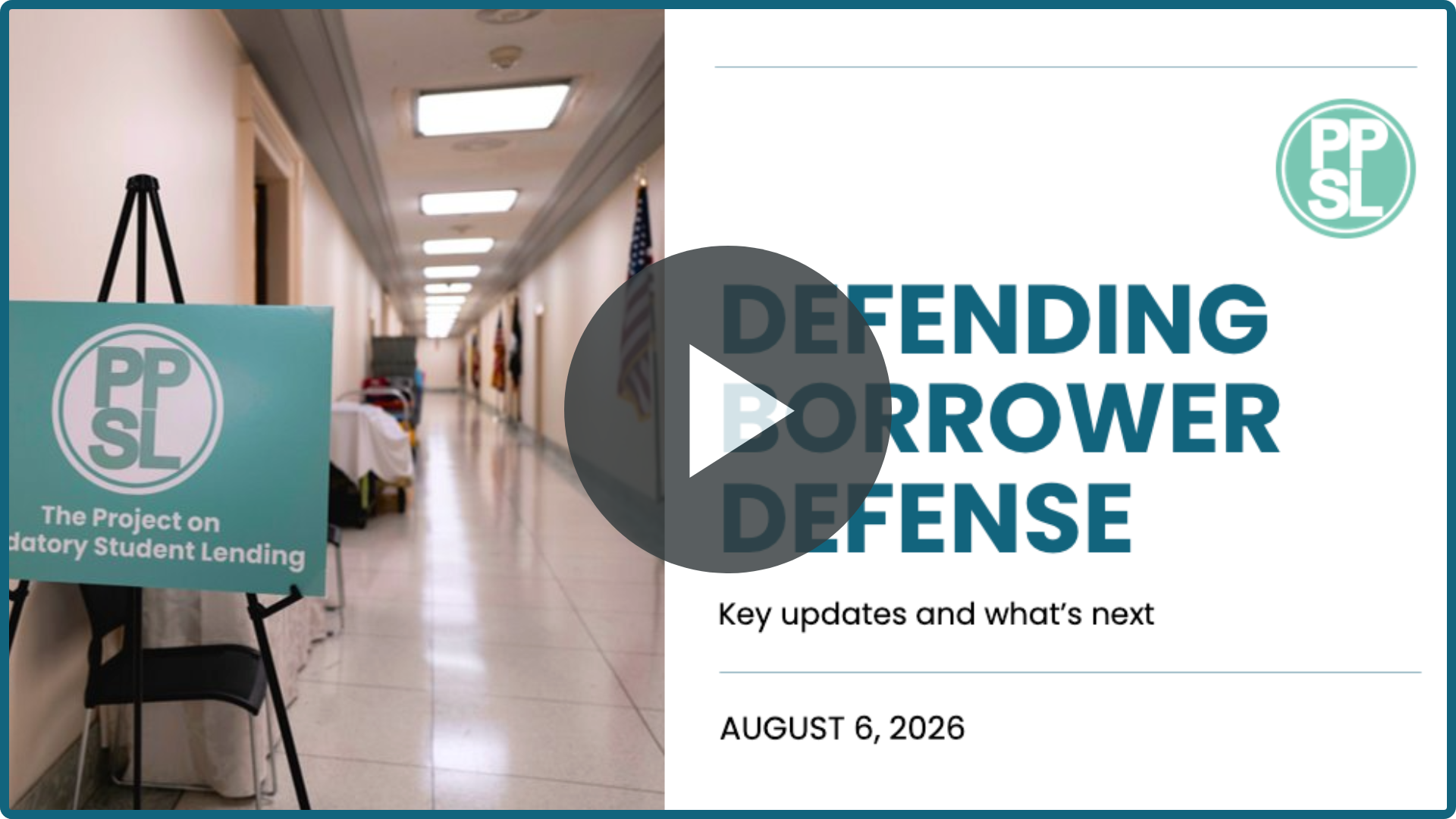
Defending Borrower Defense Webinar
This webinar helps borrowers navigate the rapidly changing borrower defense landscape.
Although the Sweet v. McMahon settlement resolved borrower defense applications filed before November 16, 2022, hundreds of thousands of newer applications remain pending, and recent changes to federal student loan policy have created new uncertainty for borrowers seeking relief. During the webinar, PPSL attorneys broke down what's changed, what borrowers should expect, and what steps they can take now.
If you missed it, you can view the recording and the slides below.
Borrower Defense Resource Toolkit
Borrower Defense Claims for the Sweet v. McMahon Class: Find the number of applicants by US state and territory.
PPSL and TICAS released a series of materials sharing facts about this longstanding policy on student debt relief that has increasingly coming under attack:
Borrower Defense 101: A summary of the history of borrower defense and how it has been implemented over the last 30 years.
Myths vs. Facts: Debunking myths and misconceptions that have been used in recent attacks against the rule.
Overview Fact Sheet: A one page overview of borrower defense, the attacks against it, and what steps must be taken to protect borrowers.
In the News




Help For Borrowers
We know that many borrowers don’t know about it or have not trusted the Borrower Defense process. The Borrower Defense process has been difficult to navigate, and we have been the first to hold the Department accountable for failing to follow the law on borrower defense. But, because borrowers have come forward and have fought back, we have made progress. In the past year, the Department has granted more borrower defense applications than ever.
If you attended a school that cheated, lied to, or misled you, don’t wait, apply for Borrower Defense to Repayment.
Sweet v. McMahon
If you applied for borrower defense before November 16, 2022, you may be eligible for certain procedures under our settlement in the Sweet v. McMahon class action case against the Department of Education, including a guarantee that you will receive an answer on your application within 36 months of the settlement’s effective date.
For more information, please visit our Sweet settlement FAQs.
Spread the word!
Join us in encouraging those who were cheated by a predatory for-profit college to apply for the debt cancellation they are legally owed under borrower defense. This process is free, and does not require special expertise.
Here’s how you can help:
Post on social media (Tag us on X/Twitter)
Post in community groups with fellow student borrowers
Email friends and former classmates to make sure they’ve filed their borrower defense
Say no to scammers. The borrower defense application is straightforward and free. Anyone who asks you for money to file an application is a scammer.